Author: Leslie Metzger

  • FHFA RCV Ruling – What Changed and Why It Matters

    FHFA RCV Ruling – What Changed and Why It Matters

    Written by Donald J. Brown, Navigator Consulting, Senior Advisor for Tellum

    FHFA Eliminated the 2024 Full-RCV Requirement

    In 2024, FHFA imposed a rule requiring full Replacement Cost Value (RCV) homeowners’ insurance for all properties with federally backed mortgages:

    • No Actual Cash Value (ACV) roof coverage allowed
    • Higher premiums for condo associations and single-family homeowners
    • Many properties risked becoming ineligible for GSE financing
    • This rule was widely criticized for driving up insurance costs and limiting consumer choice. FHFA has now scrapped that requirement.

    ACV Roof Coverage Is Now Allowed

    The new FHFA ruling permits Actual Cash Value (ACV) coverage for roofs on:

    • Single-family homes
    • Condominiums
    • The rest of the structure must still carry full RCV coverage. This change is intended to reduce insurance costs in states where full-RCV roof coverage has become “ridiculously expensive and hard to find.”

    Key Insurance Requirement Changes

    FHFA’s updated guidance includes several major adjustments:

    • ACV allowed for roofs
    • Condo buildings and single‑family homes can now use ACV roof coverage instead of full RCV.
    • Simplified deductible rules
      • The “maximum per‑unit deductible” rule has been simplified, making more condo projects eligible for GSE financing.
    • FHFA removed a 2024 rule that would have slowed claims and increased costs.
    • Caps on master policy deductibles
      • The maximum allowable per‑unit deductible for condo master policies is now capped at $50,000.
    • Expanded exemptions for condo reviews
      • More condo projects qualify for “exempt from review” status, reducing documentation burdens.

    Why FHFA Made the Change

    FHFA stated the goal is to:

    • Reduce insurance costs for homeowners
    • Restore consumer choice
    • Address rising premiums and limited insurance availability
    • Improve access to GSE‑backed mortgages, especially in rural and condo markets
    • FHFA Director William Pulte emphasized that the change corrects an “expensive” and “disruptive” prior mandate

    Impact on Banks, Lenders & Compliance

    For banks and mortgage lenders:

    • Lower barriers to GSE eligibility
    • More condo associations and single‑family borrowers can now meet insurance requirements
    • Reduced insurance‑related loan denials
    • ACV roof coverage makes previously ineligible properties financeable again
    • Need to update internal policies
    • Banks must revise:
      • Insurance verification procedures
      • Condo project review standards
      • RCV/ACV documentation requirements
      • Alignment with FDPA

    This ruling does not change FDPA requirements, which still require:

    • Adequate flood insurance
    • RCV for flood‑related building coverage (unless NFIP rules allow otherwise)
    • Affects hazard insurance underwriting for GSE loans
    • This ruling impacts only hazard insurance for GSE eligibility

    FHFA Insurance RCV Requirements: 2024 vs. 2026

    Replacement Cost Value (RCV) Requirements

    • Roof Coverage: Full RCV required for roofs on all GSE‑backed properties vs. ACV roof coverage allowed for single‑family and condo units
    • Structure Coverage: Full RCV required vs. Full RCV still required (no change)
    • Impact on Borrowers: Higher premiums (many properties became ineligible) vs. Lower premiums (more properties qualify for GSE financing)

    Condo & HOA Master Policy Requirements

    • Master Policy Deductibles:  Strict per‑unit deductible limits (many associations failed eligibility) vs. Simplified rules (maximum per‑unit deductible capped at $50,000)
    • Project Eligibility: Many condo projects required full review due to insurance issues vs. More projects qualify for “exempt from review” status
    • Roof Coverage for Condos: Full RCV required vs. ACV roof coverage permitted

    Hazard Insurance Flexibility

    • Consumer Choice: Limited (full RCV mandate restricted insurer options) vs. Expanded (borrowers and HOAs can choose ACV roof coverage)
    • Market Impact: Increased premiums (reduced availability in high‑risk states) vs. Potential lower premiums (improved insurance availability)

    Operational & Underwriting Impact for Lenders

    • Loan Eligibility: Many loans denied due to insurance non‑compliance vs. More loans eligible due to ACV flexibility
    • Underwriting Burden: Heavy documentation requirements vs. Reduced documentation (simplified condo review)
    • Policy Updates Needed: Required major updates to insurance verification vs. Requires reversal of 2024 updates and adoption of new ACV allowances

    Rationale Behind the Change

    • Regulatory Intent: Strengthen property protection vs. Reduce insurance costs and restore market stability
    • Industry Reaction: Strong pushback from lenders, HOAs, insurers vs. Broad support (seen as correcting an overly burdensome rule)

    Key Takeaways for Banks

    1. Consider updating hazard insurance verification procedures to allow ACV roof coverage.
    2. Condo project review standards need to reflect the new deductible cap and expanded exemptions.
    3. Internal policies from 2024 that required full RCV roof coverage should be revised or removed.


    Disclosure: The guidance and opinions expressed here are based upon the provided limited information, which should be considered solely for non-binding, informational purposes and is not intended as legal counsel.

  • Are You Regulator Ready for Your Next FDPA Exam?

    Are You Regulator Ready for Your Next FDPA Exam?

    Will you be Regulator Ready for your next Flood Disaster Protection Act [FDPA] Examination?
    Written by Donald J. Brown, Navigator Consulting, Senior Advisor for Tellum

    When did you last conduct a review of your institution’s Flood Disaster Protection Act [FDPA] Compliance Program?
    Historically, when lenders fail to regularly test the effectiveness of their Program’s top of the house FDPA Policy, Line of Business FDPA Procedures and other risk controls, that omission could result in unnecessary regulatory scrutiny and costly monetary penalties. Enforcement actions continue to uncover numerous deficiencies among lender controls, which often result in potential financial penalties and costly remediation fire drills to enhance outdated controls and address inconsistent practices.
    The key to success is centered in developing an enhanced and battle-ready understanding of FDPA compliance requirements and implementing robust, regulatory compliance controls such as:

    • Proactive preventive controls, which are designed to prevent violations of law:
      • Developing key automated systemic controls [in-house and third-party vendors]
      • Providing comprehensive, role specific employee training
    • Effective detective controls that identify existing risks or issues and promptly remediate:
      • Conducting Internal audits
      • Performing regular Testing & Monitoring [T&M] to measure control effectiveness
    • Remedial corrective controls that resolve issues identified through preventive or detective controls:
      • Completing a root cause analysis
      • Document quality control actions taken to address issues for examiners to review

    Best Practices to Ensure FDPA Compliance:

    1. Create and regularly maintain an enterprise-wide FDPA Risk Assessment to evidence ongoing prudent regulatory management to internal auditors and external regulators.
    2. Maintain a scalable and sustainable FDPA Compliance Program which enables an ongoing proactive approach to address matters requiring attention.
    3. Provide regular and role specific regulatory training to include loan officers, processors, compliance staff, vendors and senior management to address regulatory updates and reinforce key concepts. Document training completion for review by examiners.
    4. Prevent violations of law through regular reviews of and enhancements made to the FDPA Program to ensure lessons learned from T&M and audits have been implemented and correct regulatory deficiencies before they become regulatory violations.
    5. Review the Corporate FDPA Policy and Line of Business FDPA Procedures to ensure a consistent, congruent and seamless regulatory Compliance Program.
    6. Perform quality control exercises and audits to identify systemic errors and manually review all mission critical processes.

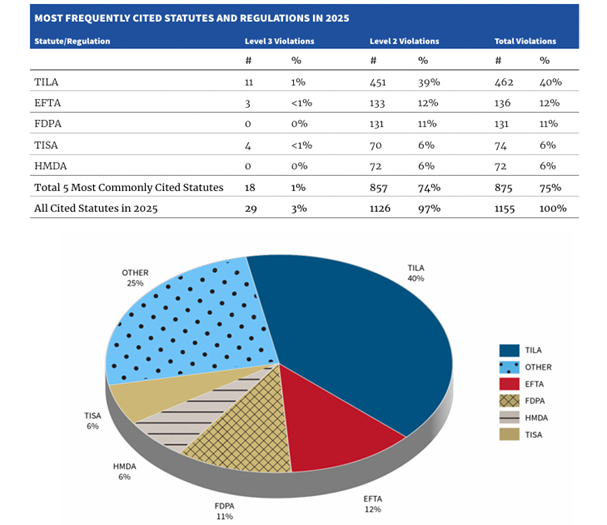
    Most common FDPA violations cited by regulators in 2025 include:

    • Failing to obtain the mandated flood insurance coverage before making, increasing, renewing or extending [MIRE] a designated loan
    • Failure to provide the required “Notice” to the borrower
    • Failure to force [lender] – placed, the mandated type and amount of insurance coverage when a coverage deficiency is identified

    FDIC – Consumer Compliance Supervisory HIGHLIGHTS  March 2026

    How can we help your institution become… Regulator Ready?

  • Joe Posavec Shares Insight on 2026 Banking Regulatory Changes with CefPro Connect

    Joe Posavec Shares Insight on 2026 Banking Regulatory Changes with CefPro Connect

    Recently, CefPro Connect shared the thoughts and analysis of our very own Joe Posavec, EVP of Tellum Advisory, regarding the Office of the Comptroller of the Currency’s (OCC) new outlines for bank regulatory changes.

    In the article, Joe breaks down the changes for this year’s regulatory landscape – from a pared down and streamlined oversight of community banks to the removal of climate change-related financial risk mandates.

    If you’d like to learn more about this, alongside Joe’s in-depth analysis on banking regulation changes from 2025 to 2026, check out the full article here or reach out to Joe directly.

  • New Service Line – Clear Course Regulatory Services

    New Service Line – Clear Course Regulatory Services

    As banks navigate regulatory compliance, examinations can occasionally result in findings that trigger formal enforcement actions. These actions typically require a timely, well-documented remediation plan and response along with prompt implementation of corrective measures.

    At this stage, banks often turn to large advisory firms, engaging sizable teams for months to document existing workflows and identify certain control deficiencies and any remediation requirements tied to regulatory findings. While effective, this approach can be costly, time-intensive, and slow to deliver actionable direction.

    We offer a pragmatic, interim alternative.

    Our model deploys two to three semi-retired, highly seasoned bank executives who have spent decades working directly with regulators and successfully executing corrective action plans. Their hands-on experience allows banks to:

    1. Proactively identify compliance issues
    2. Develop a credible action plan
    3. Engage regulators with confidence

    Clear Course services include:

    • Meeting with the bank’s executive team to fully understand examination findings
    • Identifying and prioritizing required remediation items
    • Assisting in the development of a clear, regulator-ready action plan
    • Participating in regulatory meetings, when appropriate
    • Guiding management through execution from start to finish

    Proactive Measures

    We can also conduct targeted, pre-exam reviews of key compliance areas for proactive support.

    Call Us

    In short, our team has been in your shoes. We understand regulatory expectations, know how to communicate effectively with examiners, and have a proven record of successful outcomes.

    Leverage that experience to proactively identify compliance control deficiencies, accelerate remediation, reduce disruption, and address regulatory issues with confidence.